
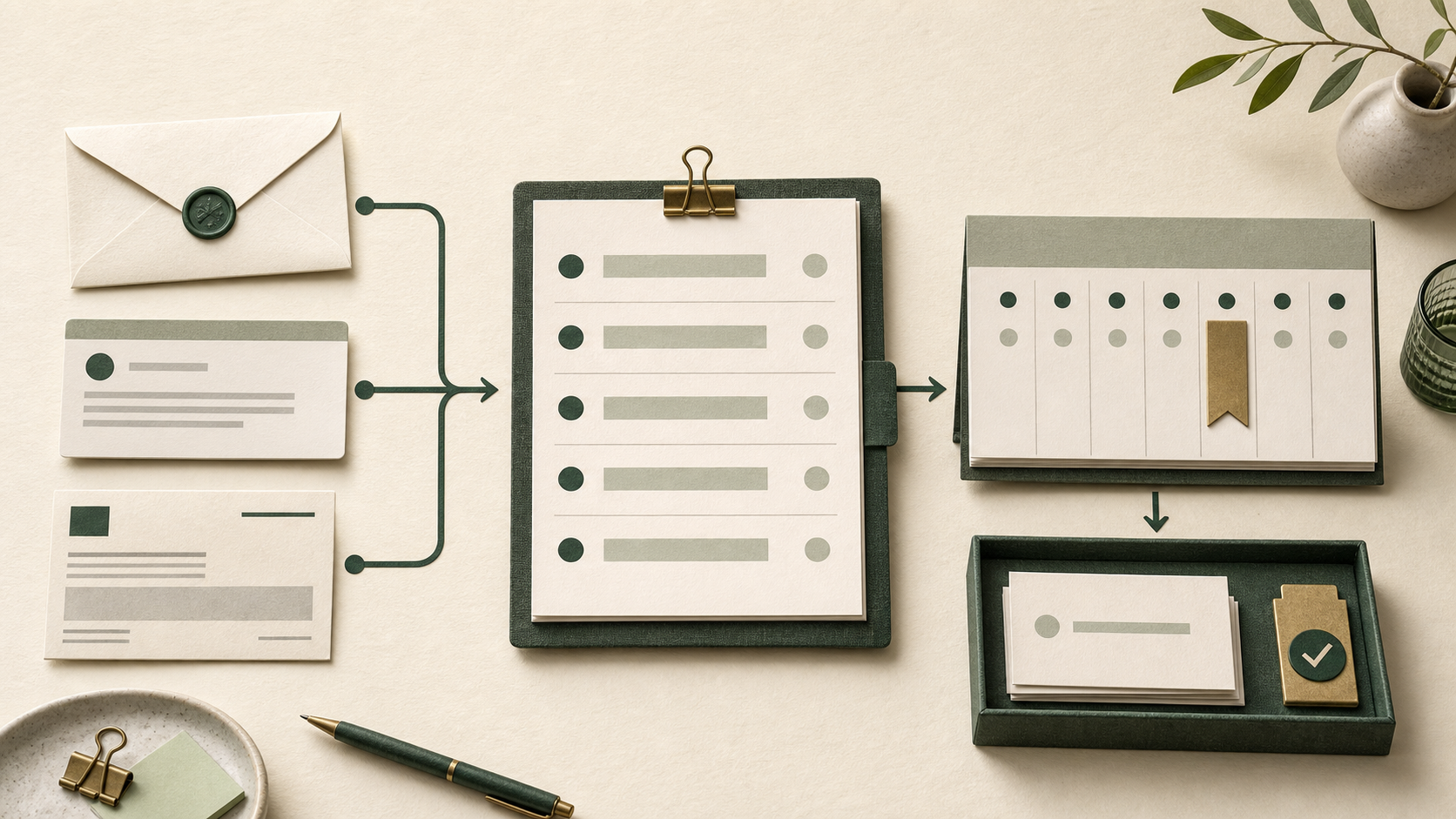
Bills become invisible when every channel has its own memory test
One bill arrives in the mail. Another appears as an email link. A third is visible only after signing in to an account. A fourth is taken automatically, but the amount changes. Remembering to check every channel turns household administration into a repeated search.
Adults with ADHD may experience difficulty with organization, time management, planning, or remembering daily tasks. The same bill-tracking problem can also come from a changed address, irregular income, shared household roles, inaccessible account systems, language barriers, a high volume of services, or companies using different delivery methods. Missing a bill is not evidence of ADHD by itself.
The smallest useful system is not another payment service. It is one privacy-safe inventory that points to the official source, shows the next date that needs attention, and separates expected, scheduled, and confirmed states.
Decide what this inventory can and cannot do
- It can show which recurring bills and renewals exist, where the official record lives, and which date or confirmation needs attention next.
- It can bring paper, email, app, and automatic-payment reminders into one review route.
- It cannot prove that an amount is correct, decide which obligation should be paid first, create money that is not available, or replace a provider's statement and applicable law.
- It should not contain full account numbers, passwords, security answers, bank details, or document images in an exposed sheet.
The inventory is a visibility layer, not a budget, payment authorization, legal record, or financial recommendation. Keep sensitive records in the provider's official account or another authorized secure location and link to that location without copying unnecessary personal data.
Give every bill one compact row
- Bill or service: a recognizable general name, such as electricity or home internet.
- Official source: the verified account, statement location, or contact route used to confirm details.
- Arrival pattern: paper, email notice, account-only statement, automatic debit, bank bill-pay, or another approved channel.
- Timing: expected statement window, next action date, and the issuer's actual due or debit date.
- Amount state: fixed, variable, or not yet known. Store an exact amount only if the inventory is appropriately protected and it is useful.
- Payment method: manual, automatic debit by the company, recurring bill-pay by the bank, or another confirmed arrangement.
- Current state: expected, received, needs action, scheduled, sent, confirmed, disputed, or support needed.
- Proof location: where the confirmation number, receipt, statement, or correspondence can be found without exposing it in the inventory.
Use only the fields that change a decision. If eight fields make the system too heavy, begin with bill, official source, next date, state, and proof location. Add a field only after a real miss shows why it is needed.
Build the first inventory from official records
- List the ordinary recurring bills and renewals you already know about; do not begin by searching years of records.
- Open each provider's official statement or account using a trusted route, not a link from an unexpected message.
- Record the issuer's current due or debit date, delivery pattern, payment method, and where confirmation appears.
- Add a next action date early enough to review a variable amount, gather missing information, or use the required delivery method.
- Mark the present state honestly. Use unknown when a detail has not been verified instead of filling the gap from memory.
- Place the inventory in the one task or administration system you already review, with access appropriate to the information it contains.
The US Consumer Financial Protection Bureau's bill-calendar guidance uses the same basic visibility principle: gather bills, list what each one is for, record the amount and due date, and check the calendar weekly. This article adds source, state, and confirmation fields because arrival and payment can occur through different systems.
Use states that do not pretend the job is finished
A checkbox labeled paid can hide several different moments. The request may have arrived, a payment may have been scheduled, funds may have been sent, or the provider may have posted the payment. Those are not always the same event.
- Expected: the bill or statement has not appeared yet, but its normal window is approaching.
- Received: the official bill is available and has not yet been checked.
- Needs action: an amount, method, question, approval, or missing resource still needs attention.
- Scheduled or sent: an instruction has been created or transmitted, but the result is not yet verified.
- Confirmed: the official provider or financial record shows the intended result.
- Disputed or support needed: the normal route is paused while the appropriate official or qualified process is used.
| State | What is known | Next check |
|---|---|---|
| Expected | The normal statement window is approaching | Confirm whether the official statement appears |
| Received | The official bill is available | Verify amount, date, method, and needed action |
| Needs action | A decision, resource, question, or approval remains | Use the authorized next step or support route |
| Scheduled or sent | An instruction was created or transmitted | Check the provider or financial record for the result |
| Confirmed | The required official evidence shows completion | Retain proof according to the applicable rule |
| Disputed or support needed | The ordinary route is paused | Use the applicable official or qualified process |
Do not move a row to confirmed because a reminder disappeared or an envelope left the desk. Record what evidence will count before the final step: provider receipt, posted transaction, cleared payment, accepted filing, or another result required by that issuer.
Run a weekly review in a fixed order
- Look ahead to the next fourteen days so the review is not limited to bills already due.
- Check expected items that have not arrived and use the verified official source to see whether delivery, address, or account settings changed.
- Open received or variable bills and compare the issuer, amount, due date, payment method, and any unusual instruction with the official record.
- Move needs-action rows into a real next action with a date, such as review statement, ask issuer, schedule payment, gather document, or request support.
- Verify scheduled, sent, and automatic items through the appropriate official account or financial record; then save the proof location and mark confirmed.
- Review renewals and cancellation boundaries separately from payment dates, then set the next review cue before closing the inventory.
Fourteen days is a planning window, not a universal grace period. Use a shorter interval or additional reminders when the actual due date, delivery time, consequence, income timing, or provider process requires it.
Apply the route to five common cases
- Variable utility on automatic debit: record the statement window, amount state as variable, scheduled debit date, and a separate confirmation check. Automatic does not mean unreviewed.
- Paper bill paid manually: move the paper through the arrival-and-action route, copy only the needed date and state to the inventory, and follow the issuer's actual instructions for when payment must be received.
- Annual subscription or insurance renewal: track the review or cancellation boundary as well as the payment date. The decision may be due before the charge appears.
- Shared household bill: name who owns the next action and where confirmation will be recorded. Do not assume that both people checking means someone acted.
- Unexpected invoice or changed payment request: mark verification needed, stop the ordinary route, and contact the organization through details you independently know to be official.
Treat automatic payments as a method, not a memory substitute
CFPB guidance distinguishes a company's automatic debit from recurring bill-pay initiated through a bank. It also advises verifying the company, reviewing the authorization terms, monitoring the account, and making sure funds are available for upcoming debits. The exact rights, notice rules, fees, and cancellation process depend on the payment type and jurisdiction.
Keep the payment method visible in the inventory because it changes what you must verify. For a variable debit, the review may focus on the statement amount, timing, available funds, and the posted result. For a manual payment, it may focus on the issuer's receipt deadline, delivery method, and confirmation.
Stopping an automatic payment does not necessarily cancel a contract or erase an amount owed. Use the provider's and financial institution's official processes, keep records of requests, and obtain qualified local advice when rights or consequences are unclear.
Pause for scams, errors, and payment difficulty
- Unexpected urgency, a new payment destination, an unfamiliar invoice, or a request for unusual payment methods: do not use the message's link or contact details until the request is independently verified.
- Wrong amount, duplicate charge, missing credit, unauthorized transaction, or a payment not posted: mark the row disputed and follow the issuer's, provider's, or financial institution's official dispute process promptly.
- Not enough money to make a payment: do not hide the row or move the date to make the inventory look clear. Contact the company or appropriate local service promptly to ask about available options and record the next official step.
- Collection notice, threatened shutoff, court paper, housing risk, tax issue, benefit decision, medical bill, or another high-consequence matter: use the applicable official or qualified support route rather than relying on a weekly home-admin review.
The US Federal Trade Commission warns that impersonators can place themselves between a consumer and the real biller. If a request is surprising, contact the organization through a website, statement, card, or number you independently know is genuine.
Repair the system at the point where it failed
- A bill never reaches the inventory: connect its arrival channel to the paperwork tray, email route, or account-review cue instead of adding another reminder downstream.
- The list is too long to review: hide confirmed historical rows from the active view, but retain records only as required by the provider, applicable rules, and your authorized storage policy.
- Dates keep changing: store the next verified date and a note that the cycle varies; do not preserve an old date because it looks tidier.
- Automatic items are missed: create a scheduled verification state and review variable amounts and available funds before the debit when needed.
- The sheet contains too much sensitive data: remove account details and replace them with a safe pointer to the official record.
- Weekly review is repeatedly skipped: attach it to an existing administration cue, shorten it to the next fourteen days, and leave a restart note showing the first unchecked row.
Start with three bills, not the whole financial history
Choose one fixed monthly bill, one variable bill, and one annual or irregular renewal. Add one row for each using the official record, then schedule a fifteen-minute weekly review. The test is whether you can tell what is expected, what needs action, and what is confirmed without reopening every channel.
If a bill is already late, disputed, unaffordable, connected to fraud, or tied to legal or essential-service consequences, skip the setup exercise for that item and contact the appropriate provider, financial institution, official agency, qualified adviser, or local support service now.
Thank you for treating visibility as a system problem rather than a character test. Today, create only the five starter fields—bill, official source, next date, state, and proof location—and enter one low-risk bill. One accurate row is enough to begin.
Sources and further reading
Sources support the health and diagnostic context. Practical workflow suggestions are low-risk editorial adaptations, not clinical treatment.
- NIMH: ADHD in Adults—4 Things to Know (checked July 13, 2026)
- NICE guideline NG87: ADHD diagnosis, management, and environmental modifications (checked July 13, 2026)
- US CFPB: Bill Calendar—Know what you owe and when it is due (checked July 13, 2026)
- US CFPB: How automatic payments from a bank account work (checked July 13, 2026)
- US CFPB: How to stop automatic payments from a bank account (checked July 13, 2026)
- US FTC: Pay your bills, not impersonators (checked July 13, 2026)