
Laundry often stops after one step is technically finished
“Why can I start a load but still end up with wet clothes in the washer, dry clothes in a basket, and yesterday's clothes on a chair?” The word laundry hides several different jobs: gathering, checking, washing, drying, sorting, carrying, folding or hanging, and returning items to several locations.
Adults with ADHD may experience difficulty with organization, planning, remembering daily tasks, or completing larger projects. The same laundry backlog can also come from pain, fatigue, limited mobility, sensory discomfort, shared-household ambiguity, inaccessible machines, lack of drying space, irregular schedules, or too few clothes for the available wash cycle. A stalled load is not evidence of ADHD by itself.
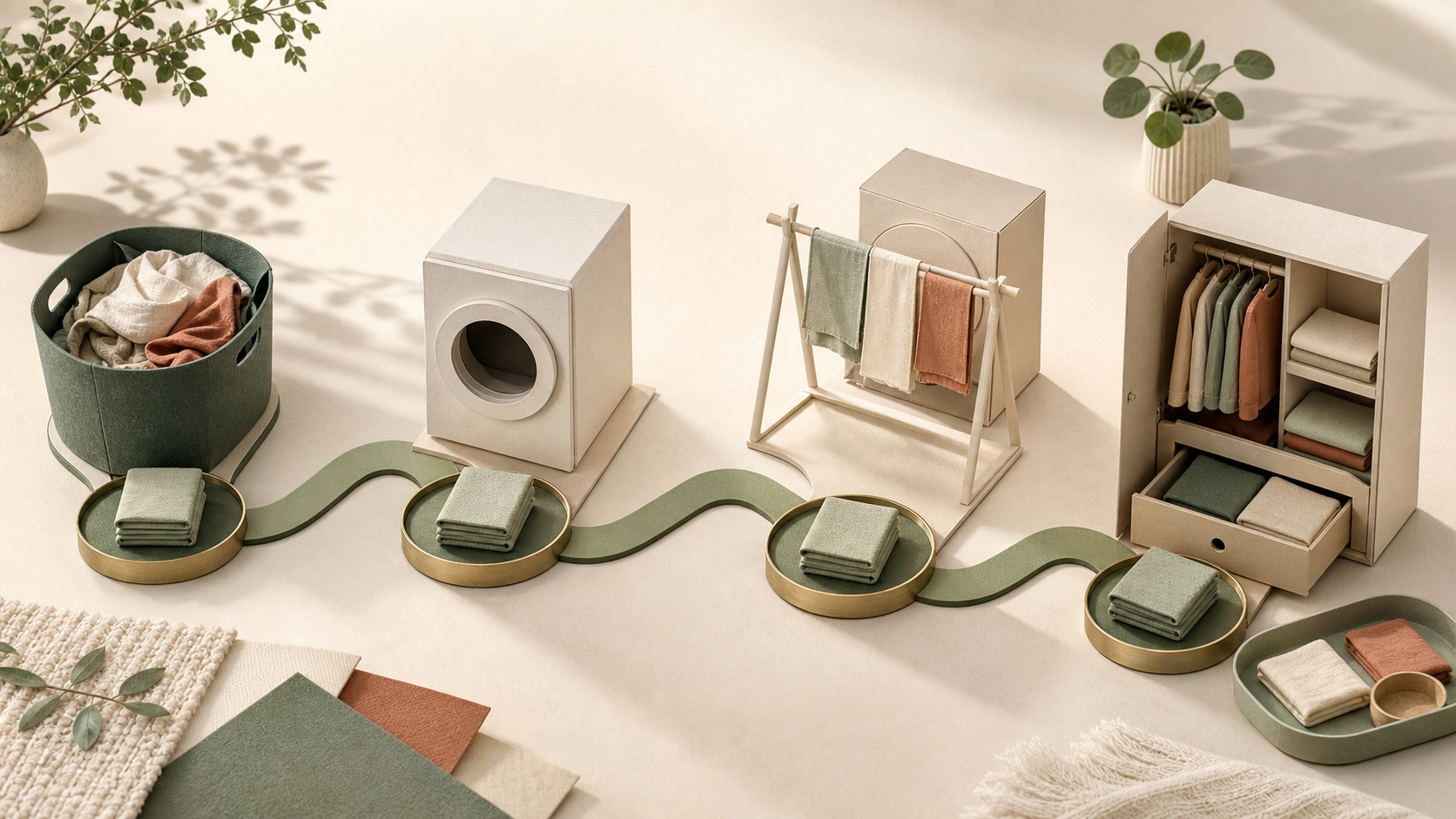
The shortest useful answer is to treat laundry as four handoffs—collect, wash, dry, and return—then repair the first handoff whose next state is not visible or realistic. You do not need a perfect laundry room to test one station.
Audit one real load before buying another basket
- Choose one ordinary, low-risk load rather than the entire backlog.
- Observe where it begins and where it first waits longer than intended.
- Name the state at that point: dirty but unsorted, ready to wash, wet and needs drying, dry and needs returning, or held for instructions.
- Write the next observable movement, such as carry hamper to machine, move approved items to drying, or put shirts on hangers.
- Identify the missing condition: compatible items, care instruction, detergent, machine access, drying space, physical capacity, time cue, owner, or storage home.
- Change only that station for the next load and record whether the handoff became easier.
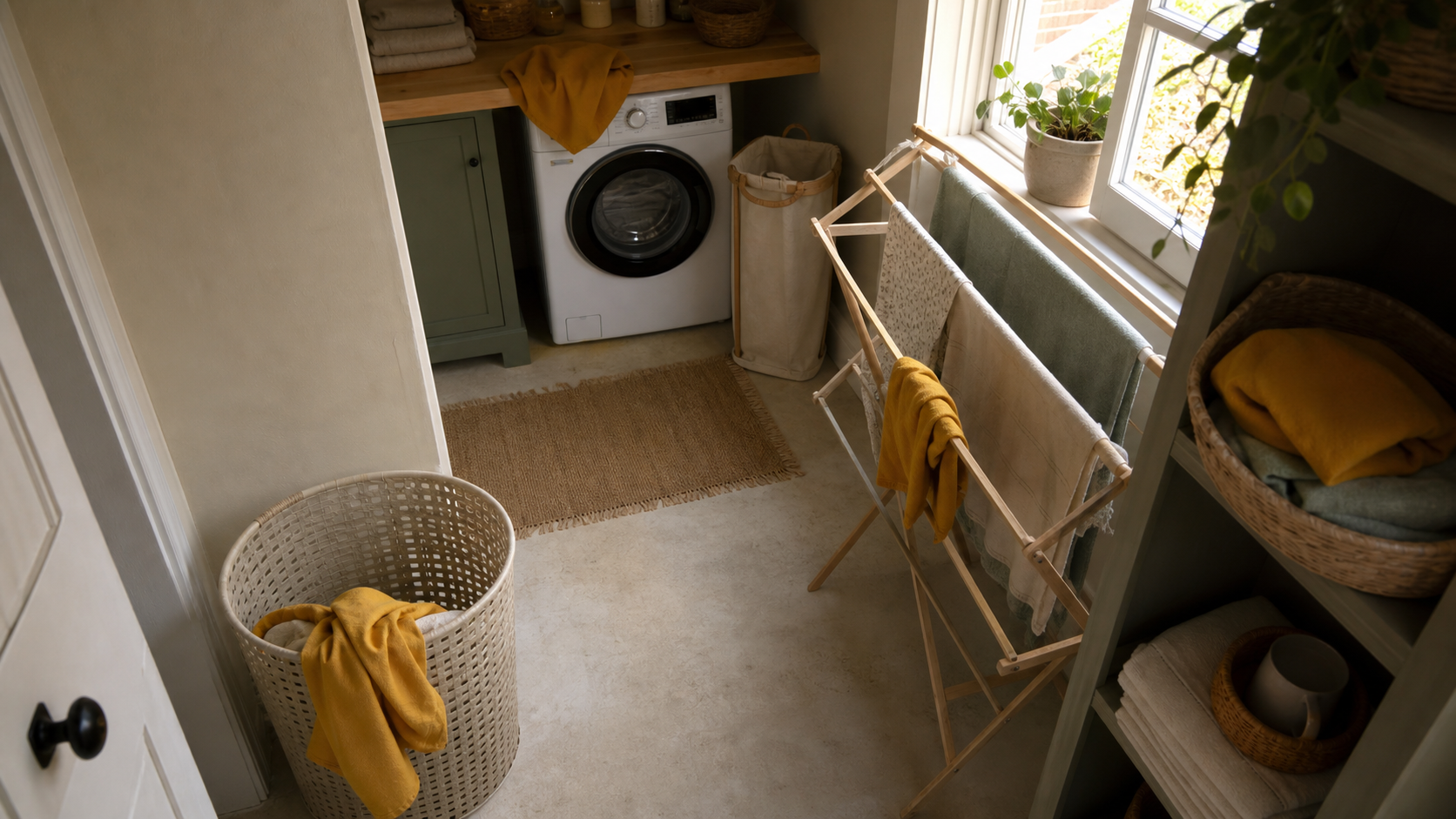
A new container helps only when it gives one state a clearer home. If it merely creates another place where mixed laundry can wait, it adds a search rather than removing one.
Give the four stations different jobs
- Collect: items are known to be dirty and are waiting for the care decision or a compatible load.
- Wash: one compatible load is verified, supplied, and ready for the machine or approved service.
- Dry: washed items are moving through the drying method allowed by their care instructions.
- Return: clean, fully dry items are moving to the place where they can be used again.
Keep held items outside the ordinary flow when their care instruction, contamination, damage, ownership, or safe method is unclear. The hold state prevents one unusual item from blocking every routine item behind it.
Use a compact load card when the handoffs disappear
- Load name: a plain description such as everyday darks or household towels, not a person's private details.
- Owner: who has agreed to move or check the load next in a shared household.
- Care route: the verified wash and drying instructions that apply to every included item.
- Ready condition: what must be present before starting, including machine access and the permitted product.
- Finish cue: where the machine or service signals completion and which backup cue will bring the load back into view.
- Next movement: the first physical action after the current cycle ends.
- Done state: the specific drawer, hanger, shelf, open bin, or other safe usable home for the dry items.
- Hold reason: the instruction, repair, contamination question, capacity, or decision that prevents normal processing.
The card is optional. Use it only when another person, a delayed machine cycle, a shared facility, or an unusual care route makes the state hard to reconstruct. One line on a reusable note can be enough.
At collect, sort only by the next care decision
Place the dirty-laundry point where clothes actually come off, within the household's safety and access limits. If one hamper repeatedly overflows, the first question is whether collection capacity matches the normal interval—not whether the household needs a complex color taxonomy.
Separate an item at collection only when its label, soil, color-transfer warning, material, contamination, or required method changes the next action. The US Federal Trade Commission's guidance explains that US garment care labels can include washing, drying, bleaching, ironing, and warnings about methods that may harm the item or other items. Rules and symbols differ by market, so use the attached label and applicable local guidance rather than guessing from appearance.
If the care label is missing or unclear, move the item to a small hold place and verify the manufacturer, retailer, textile professional, or other appropriate source. Do not let one uncertain item stop an otherwise compatible routine load.
At wash, make ready a real state
- Compatible items are selected according to their actual care instructions.
- Pockets, closures, removable parts, stains, and special warnings are handled only as the garment and product instructions require.
- The machine is available, suitable, and within the load and use limits in its manual.
- The permitted detergent or other product is available in its original labeled container and can be measured or used according to its directions.
- A safe drying route has space before the wash starts.
- The completion signal and the next-action cue are both set where they can be noticed.
The US Consumer Product Safety Commission warns that concentrated single-load liquid laundry packets can seriously injure children and advises keeping them sealed in their original packaging, locked up, and out of children's sight and reach. A visible laundry station must not make hazardous products accessible. For any exposure, use the product label and the local poison or emergency service rather than an organizational checklist.
At dry, attach the next cue before the wash begins
The most fragile handoff may occur when the washer finishes but the person has moved to another room or task. Set one cue for the expected end and a separate follow-up cue that names the next action, such as move approved items to drying. If someone else owns the handoff, record that agreement rather than assuming they heard the machine.
Follow each item's drying instructions and the appliance manual. Items may require tumble drying, line drying, flat drying, professional care, or another method; a productivity shortcut cannot decide which method is safe.
For US home fire safety, the US Fire Administration reports that failure to clean was the leading factor contributing to ignition in home clothes-dryer fires from 2018 through 2020. Its guidance says major appliances such as washers and dryers should be plugged directly into a wall outlet rather than an extension cord; its dryer materials also advise using the lint filter, cleaning it each cycle, keeping the vent unrestricted, and having equipment installed and serviced appropriately. Follow the current appliance manual, building rules, and local fire-safety guidance for the equipment in use.
At return, choose the minimum usable home
Returning does not have to mean that every item receives the same folding ritual. The done state can be hanging, folded, laid flat, or placed in a defined open bin when that method is safe for the item, fits the space, and works for the people using it.
Reduce decisions by grouping at the point of use: one household member, one room, or one repeated item type. Carry each group to its destination rather than creating a second mixed clean pile elsewhere. If folding is the high-friction step, test direct hanging, fewer folds, or a no-fold home for suitable routine items without ignoring care, space, accessibility, or household agreements.
A clean basket can be an intentional home if it is stable, identifiable, accessible, and kept separate from dirty or damp items. If it constantly overflows or must be searched item by item, it is a waiting station and needs a smaller return decision.
Apply the four stations to five common cases
- Shared household: give each active load one owner and one visible state. Shared responsibility is not the same as an assigned handoff.
- Small home or no fixed laundry room: let one portable container change role only after it is emptied and the state is obvious; do not mix dirty, wet, and clean items in one ambiguous pile.
- Laundromat or shared machine: verify current facility rules, access, payment, cycle, supervision, collection, and closing conditions through the official source; keep the load with you as required and use a safe transport plan.
- Line-dry or flat-dry item: reserve the approved drying space before washing so the wet stage does not become an emergency improvisation.
- Pain, fatigue, mobility, or sensory load: reduce carrying distance, batch size, reaching, texture handling, or folding decisions; seek appropriate support or an accessible service when the task cannot be made safe at home.
Pause ordinary laundry for non-routine hazards
- A damaged appliance, unusual heat, burning smell, smoke, sparking, damaged cord, gas concern, repeated fault, or blocked vent: stop using the equipment and follow the manufacturer, building, utility, fire, emergency, or qualified repair process that applies.
- Possible exposure to detergent or another laundry product: use the product label and local poison or emergency service promptly; do not wait for the next household review.
- Clothing exposed to fuel, solvents, hazardous material, pests, bodily fluids, or an infectious concern: keep it out of the ordinary route and follow the relevant workplace, public-health, healthcare, pest-control, waste, or professional guidance.
- An item with no safe confirmed cleaning method: hold it separately and ask the manufacturer or an appropriate textile professional instead of testing an improvised method on a full load.
Repair the station that keeps failing
- Dirty clothes miss the hamper: move the collection point onto the actual undressing route, without blocking exits or creating access hazards.
- Loads wait beside the washer: define what ready means and remove the one missing condition before adding more sorting categories.
- Wet items are forgotten: pair the machine signal with a named follow-up cue and make drying space ready first.
- Dry items live on a chair: place a small return station closer to the point of use or reduce the folding standard for suitable items.
- One unusual item blocks everything: create a bounded hold state with one verification action.
- The system requires too many containers: remove any container that does not represent a different state or change the next decision.
Start with the first stalled handoff
Choose one ordinary load and write its four intended states: collected, ready to wash, safely drying, and returned to a usable home. Stop at the first state whose location, owner, cue, or next movement is unclear. That is the station to change this week.
If the load involves a damaged appliance, product exposure, a fire or electrical warning, hazardous contamination, essential medical items, an inaccessible task, or another serious safety concern, skip the workflow experiment and use the relevant official, emergency, qualified repair, healthcare, workplace, or support route.
Today, do not reorganize the whole laundry area. Move one ordinary load to its next named state and leave the next cue where it will reappear. A single clean handoff is enough to test the map.
Sources and further reading
Sources support the health and diagnostic context. Practical workflow suggestions are low-risk editorial adaptations, not clinical treatment.
- NIMH: ADHD in Adults—4 Things to Know (checked July 14, 2026)
- NICE guideline NG87: ADHD diagnosis, management, and environmental modifications (checked July 14, 2026)
- US FTC: Clothes Captioning—Complying with the Care Labeling Rule (checked July 14, 2026)
- US CPSC: Single-Load Liquid Laundry Packets—Toxic, Harmful to Children (checked July 14, 2026)
- US Fire Administration: Appliance and Electrical Fire Safety (checked July 14, 2026)
- US Fire Administration: Clothes Dryer Fire Safety (checked July 14, 2026)