
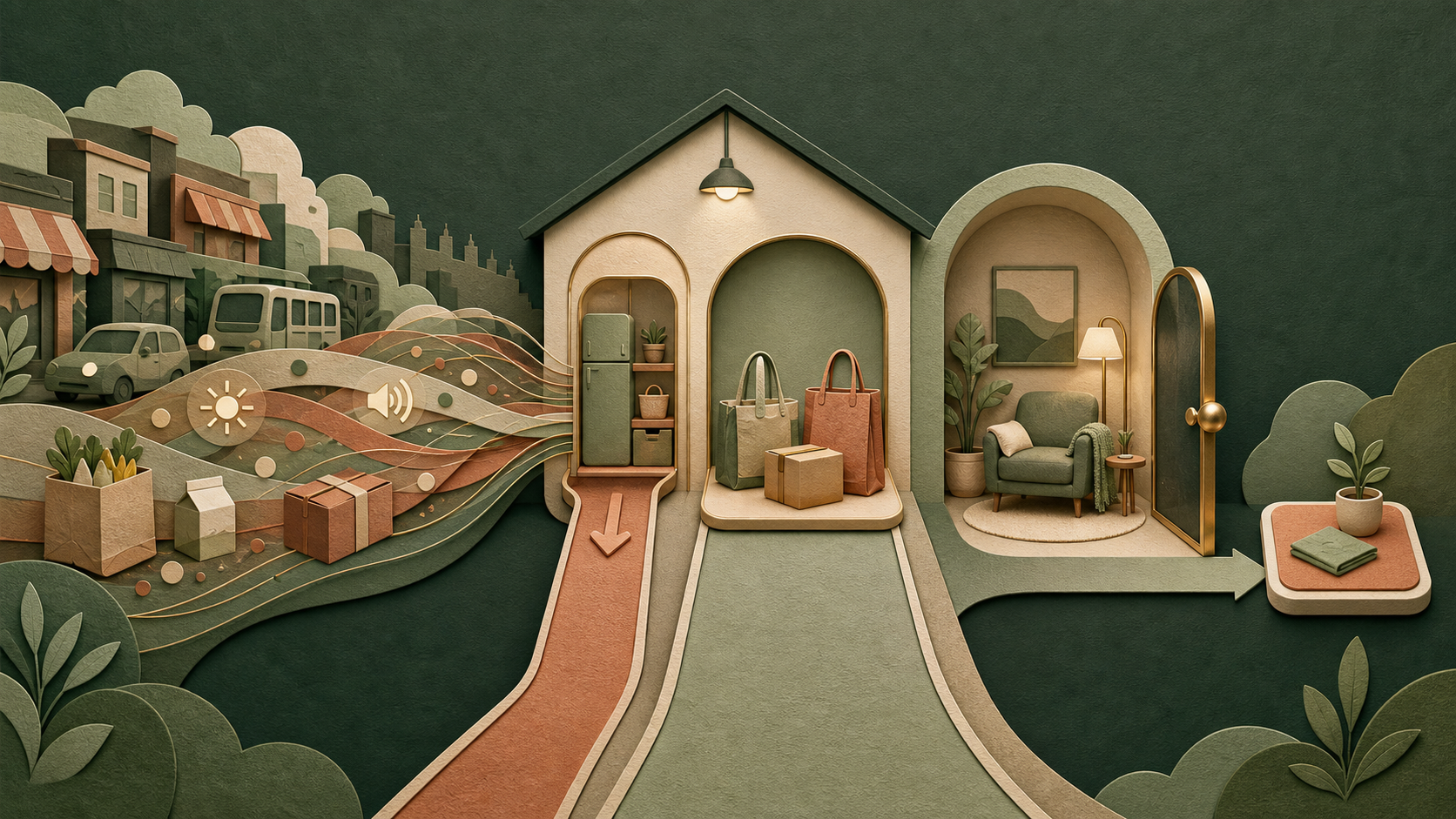
The errand can be over while the transition is still happening
“Why can I finish the shopping or appointment but lose the rest of the day when I get home?” A short trip can contain navigation, traffic, waiting, bright or noisy spaces, conversations, decisions, carrying, schedule changes, and the effort of staying oriented in an unfamiliar process. Crossing the front door does not instantly remove those demands.
Adults with ADHD may experience difficulty with planning, organization, time management, daily tasks, or doing several things at once. The same post-errand difficulty can also follow poor sleep, pain, illness, disability, heat, hunger, medication effects, caregiving, a demanding journey, sensory load, anxiety, or an unrealistic schedule. Needing transition time is not evidence of ADHD by itself, and an article cannot determine its cause.
The practical answer is to reserve a recovery buffer before the trip begins. The buffer is not a promise that you will feel completely restored. It is a bounded transition that protects time-sensitive unloading, lowers avoidable input, and postpones the next optional demand until one planned check point.
Separate recovery from avoidance and from medical care
- Recovery buffer: a planned period between a demanding trip and the next optional task, with a clear beginning and a later decision point.
- Urgent return lane: actions that cannot safely wait, such as bringing a child or dependent inside, following medicine instructions, refrigerating perishables, securing valuables, or responding to an actual hazard.
- Deferred lane: bags, messages, receipts, household decisions, and optional chores that can wait in a defined safe place.
- Escalation lane: severe, sudden, rapidly worsening, or otherwise concerning physical or mental symptoms; unsafe driving; heat illness; injury; exposure; or another condition that needs emergency, healthcare, poison, transport, or qualified support rather than a productivity routine.

A buffer should not hide a fixed deadline, leave a dependent unsupported, delay required medication handling, keep perishable food at an unsafe temperature, or replace medical advice. Move those conditions to the correct lane first; the ordinary household system begins only after immediate responsibilities are safe.
Map load before, during, and after the trip
- Before: note the departure preparation, travel, uncertainty, and decisions required to begin.
- During: note waiting, navigation, conversation, noise, light, temperature, movement, carrying, and changes to the plan.
- After: note unloading, food or medicine handling, receipts, messages, changing clothes, washing, helping another person, and deciding what happens next.
- Mark which after-actions are truly time-sensitive, which are merely visible, and which can be moved to a later review.
- Choose one source of input that can be lower on return and one check point when the next demand will be reconsidered.
This is a personal planning map, not a clinical scale. Use low, medium, high, or unknown only to compare your own trips. A new place, a medical appointment, a complicated return, or unpredictable transport can honestly be marked unknown.
Reserve the buffer on the calendar before adding another task
Place the trip's real door-to-door window on the calendar, including travel, check-in, queues, transfers, and the return journey. Then add a visible transition block before the next optional appointment, call, household project, or focused work session. A task scheduled immediately after arrival assumes that unloading and switching take no time.
Do not use one universal number. A ten-minute transition may fit a familiar pickup and fail after a crowded appointment; a longer block may be unnecessary after an easy local stop. Start with an estimate, compare it with what actually happened, and revise the next similar trip. If the next commitment is fixed, shorten the errand route or remove an optional stop rather than pretending the transition can disappear.
Record the buffer as a real part of the plan, not as empty time available to other people by default. In a shared household, say what the block protects and agree who owns any immediate child, pet, meal, delivery, or caregiving handoff.
Build a five-state return strip
- Arrive safely: finish driving, cycling, walking, transit, or mobility-device travel before reviewing messages or changing the plan.
- Unload urgent: move only people, animals, medicines, perishables, mobility equipment, hazardous or temperature-sensitive items, and required security items according to their instructions.
- Park the rest: place ordinary bags, papers, and returns in one stable arrival zone that does not block an exit or expose private information.
- Lower input: move to a personally suitable space and reduce one avoidable demand, such as overlapping audio, bright screen alerts, uncomfortable outerwear, conversation, or standing.
- Recheck: at the planned cue, decide whether to begin one next action, extend or change the transition, ask for support, or reschedule an optional demand.
The strip prevents every object and decision from arriving with equal urgency. It also gives the buffer an exit: not “feel perfect,” but reach the planned recheck with immediate safety handled and enough information to make the next decision.
Prepare the landing before leaving
- Clear one safe landing area near the actual return route for ordinary bags and paperwork.
- Prepare the approved destination for perishables, medicine, mobility equipment, wet items, or anything else that has special handling instructions.
- Choose the lower-input location you can realistically reach without first cleaning or moving furniture.
- Put a simple option there that you already know is acceptable, such as permitted water, a seat, lower lighting, quiet, or a familiar low-demand activity; individual health, accessibility, and household requirements take precedence.
- Set one named cue for the recheck and write the next optional task in observable words so it does not have to be reconstructed from memory.
- Tell other household members what is urgent on return, what can wait, and when you will review the next shared decision.
Do not turn the recovery area into a new shopping project. The useful test is whether one ordinary return requires fewer immediate decisions, not whether the space looks like an ideal wellness room.
Choose a check point, not a recovery deadline
A fixed timer can make the transition visible, but it cannot determine whether a person is medically recovered or safe for a demanding task. Use the cue as a decision point. When it appears, check the current facts: Is urgent unloading complete? Has the main avoidable input been lowered? Is the next task still required today? Can it be reduced to one safe, reversible action? Is support or a schedule change needed?
If the next action is optional and the load is still high or unclear, extending the buffer or rescheduling can be the correct result. If the next action is fixed and consequential, use the agreed backup, communicate through the appropriate channel, or seek qualified help instead of silently hoping that the original schedule will work.
Avoid using productivity language to override pain, marked drowsiness, faintness, breathing difficulty, confusion, severe distress, or another concerning change. Use local emergency or healthcare guidance when symptoms are severe, sudden, worsening, or concerning to you.
Apply the buffer to five common returns
- Groceries after several stops: reserve enough route capacity to bring perishables in promptly according to food-safety instructions. Park shelf-stable bags in the arrival zone and defer receipt sorting or cupboard reorganization.
- Medical or administrative appointment: protect the required follow-up instructions, documents, medicines, and transport. Put optional explanation, messaging, and form-filing after the check point unless the provider gave a time-sensitive direction.
- Crowded shop or event: lower the most changeable input on return instead of trying to create total silence, darkness, and isolation. Record which part of the trip created the load only after immediate needs are handled.
- Shared-household trip: assign the urgent unload and caregiving handoffs before departure. One person can take the buffer while the other owns an agreed essential task, but neither should have to guess.
- Transit, walking, cycling, or mobility-device trip: include the final transfer, building entrance, stairs, weather exposure, charging, and equipment storage in the trip. Arrival at the stop nearest home may not be the end of the load.
Keep driving and environmental hazards outside the experiment
The US National Highway Traffic Safety Administration warns that drowsy driving is dangerous and that caffeine alone may not make a seriously sleep-deprived driver safe. A home recovery plan begins after safe travel; it is not a reason to continue driving when drowsy, impaired, distressed, affected by medicine, or otherwise unsafe. Stop in a safe place and use an appropriate alternative or official route.
Hot weather can change an ordinary errand into a health risk. The US Centers for Disease Control and Prevention advises staying cool, staying hydrated, and knowing when to seek medical care; it also notes that hot days can affect anyone and can worsen some health conditions. Check current local heat and air-quality information, follow individual clinical advice, and do not treat symptoms of overheating as routine sensory fatigue.
Do not leave children, dependent adults, pets, medicines, perishables, hazardous products, mobility aids, or valuables in a vehicle or arrival area contrary to the rules and instructions that apply. Fire, gas, electrical, security, exposure, or building-access concerns use the relevant emergency or qualified process before the buffer begins.
Repair the failure mode instead of abandoning the buffer
- Every bag becomes urgent: define the urgent return lane before the trip and give ordinary bags one safe parking state.
- The buffer gets filled with chores: put it on the shared calendar and name the first decision point rather than leaving it as unlabeled free time.
- The timer feels like another demand: use a gentler cue or an agreed household check-in; the cue asks for a decision, not automatic productivity.
- The next task remains vague: write one observable action before leaving, such as open the official instruction or place the form beside the laptop.
- Recovery expands without a recheck: keep one visible cue, then choose explicitly among proceed, reduce, reschedule, communicate, or seek support.
- The trip repeatedly consumes more capacity than planned: classify the route as high or unknown, split stops, protect a longer transition, change transport, use an approved delivery or remote route, or ask for appropriate assistance.
Run a seven-day one-trip test
- Choose one repeated, ordinary, low-risk trip rather than the hardest day of the month.
- Estimate the door-to-door trip and reserve a transition before the next optional demand.
- Write the urgent unload, deferred landing, lower-input option, recheck cue, and next optional action.
- After the trip, record only the actual arrival time, first stalled state, whether the urgent lane worked, and what happened at the recheck.
- For the next similar trip, change one variable: route size, buffer placement, landing location, input reduction, shared handoff, or next-task size.
The test is successful when it gives you better planning information, even if the first estimate is wrong. Do not score the day by how quickly you resumed productivity or compare your transition with another person's.
Start by protecting one return
Pick one upcoming ordinary errand and add a visible block between its realistic return time and the next optional demand. Write three lines: urgent on arrival, safe place for the rest, and recheck cue. That is enough structure for the first test.
If the trip involves urgent healthcare, severe or changing symptoms, unsafe transport, extreme weather, a dependent person's safety, essential medicine, hazardous exposure, or another high-consequence condition, bypass this experiment and use the relevant official, emergency, healthcare, accessibility, or qualified support route.
Today, protect the first five-state return strip on your calendar: arrive safely, unload urgent, park the rest, lower one input, and recheck. The goal is not to earn rest. It is to stop the next demand from arriving before the transition has been considered.
Sources and further reading
Sources support the health and diagnostic context. Practical workflow suggestions are low-risk editorial adaptations, not clinical treatment.
- NIMH: ADHD in Adults—4 Things to Know (checked July 14, 2026)
- NICE guideline NG87: ADHD diagnosis, management, and environmental modifications (checked July 14, 2026)
- Job Accommodation Network: ADHD accommodations and structured breaks (checked July 14, 2026)
- US NHTSA: Drowsy Driving—Avoid Falling Asleep Behind the Wheel (checked July 14, 2026)
- US CDC: About Heat and Your Health (checked July 14, 2026)