
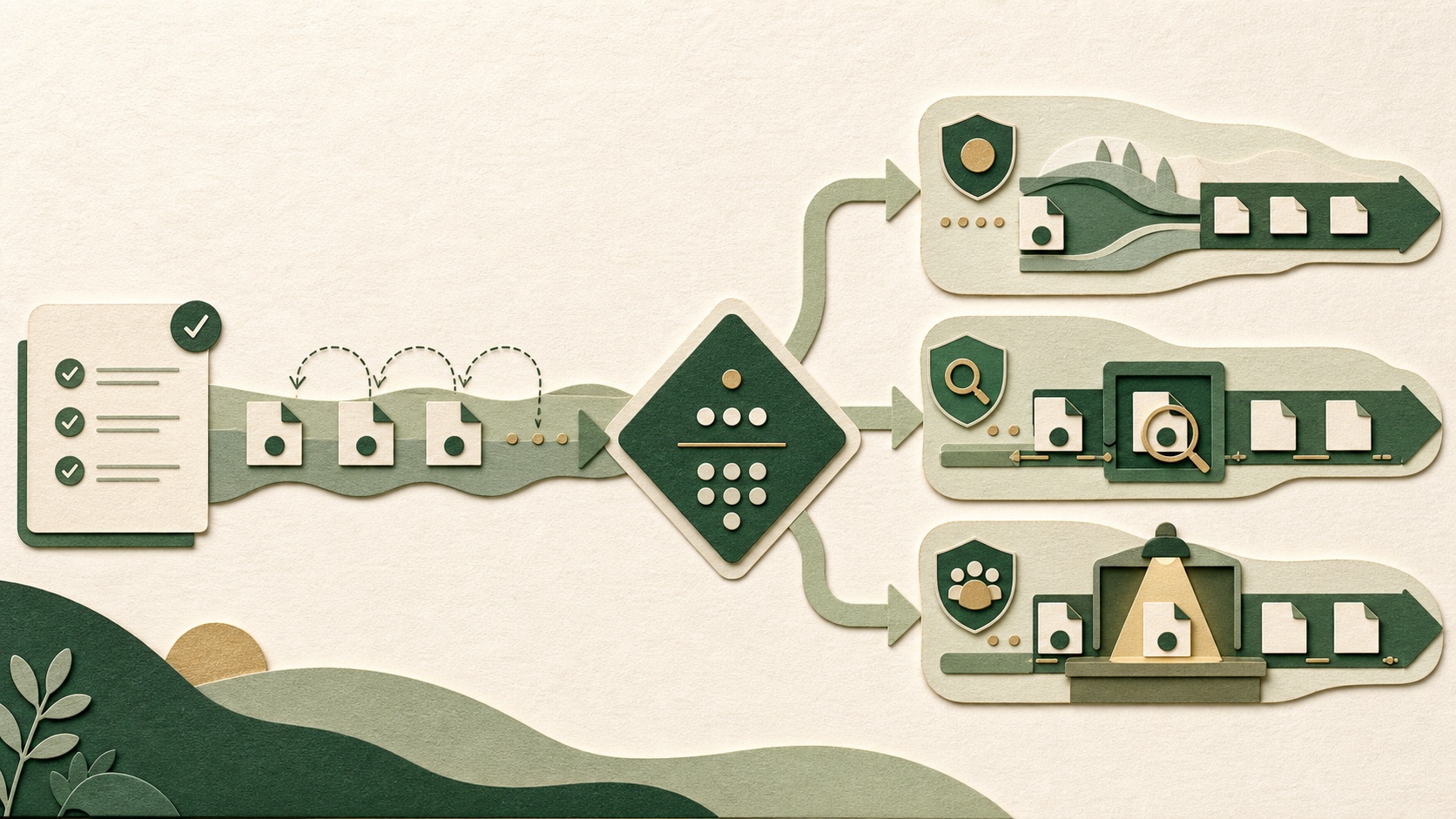
A checklist is one control, not the whole system
A short checklist can make known risk points visible at the moment of action. It works best when the task is stable, the checks are specific, the person has reliable access to the evidence, and the consequence is appropriate for a personal control.
But a checklist still requires someone to notice it, interpret it, complete it, and respond correctly—often under the same workload, interruption, ambiguity, or interface conditions that contributed to the error. Adding another checkbox may document the problem without changing the path that produces it.
Adults with ADHD may experience difficulty sustaining attention to details, organizing tasks, or completing work. Similar repeated mistakes can also arise from fatigue, excessive workload, poor instructions, missing data, confusing interfaces, unsafe incentives, inadequate staffing, or a process that makes two options easy to confuse. A repeated error is not evidence of ADHD or bad character by itself.
Describe the event before choosing the fix
- State the observable error: what was missing, incorrect, late, duplicated, sent, selected, or not verified.
- Identify where it entered the process and the last point where it could have been detected.
- Record the actual or plausible consequence without exaggerating it.
- Note frequency, conditions, workload, interruptions, interface, inputs, and whether the procedure was usable.
- Check whether the same pattern appears across people, shifts, locations, or tools.
- Preserve evidence through the organization's approved incident, quality, or improvement process when one applies.
Do not create a private log containing client, patient, employee, financial, security, or other confidential information. Use the authorized reporting and records system for the work.
Separate four different control problems
- The check is absent: nobody defined the known risk point.
- The check is vague: “be careful” does not say what evidence to compare.
- The check is hard to perform: the source is missing, access is delayed, or the interface hides the condition.
- The check is too weak: one person's attention is the final barrier before a consequence that needs a stronger control.
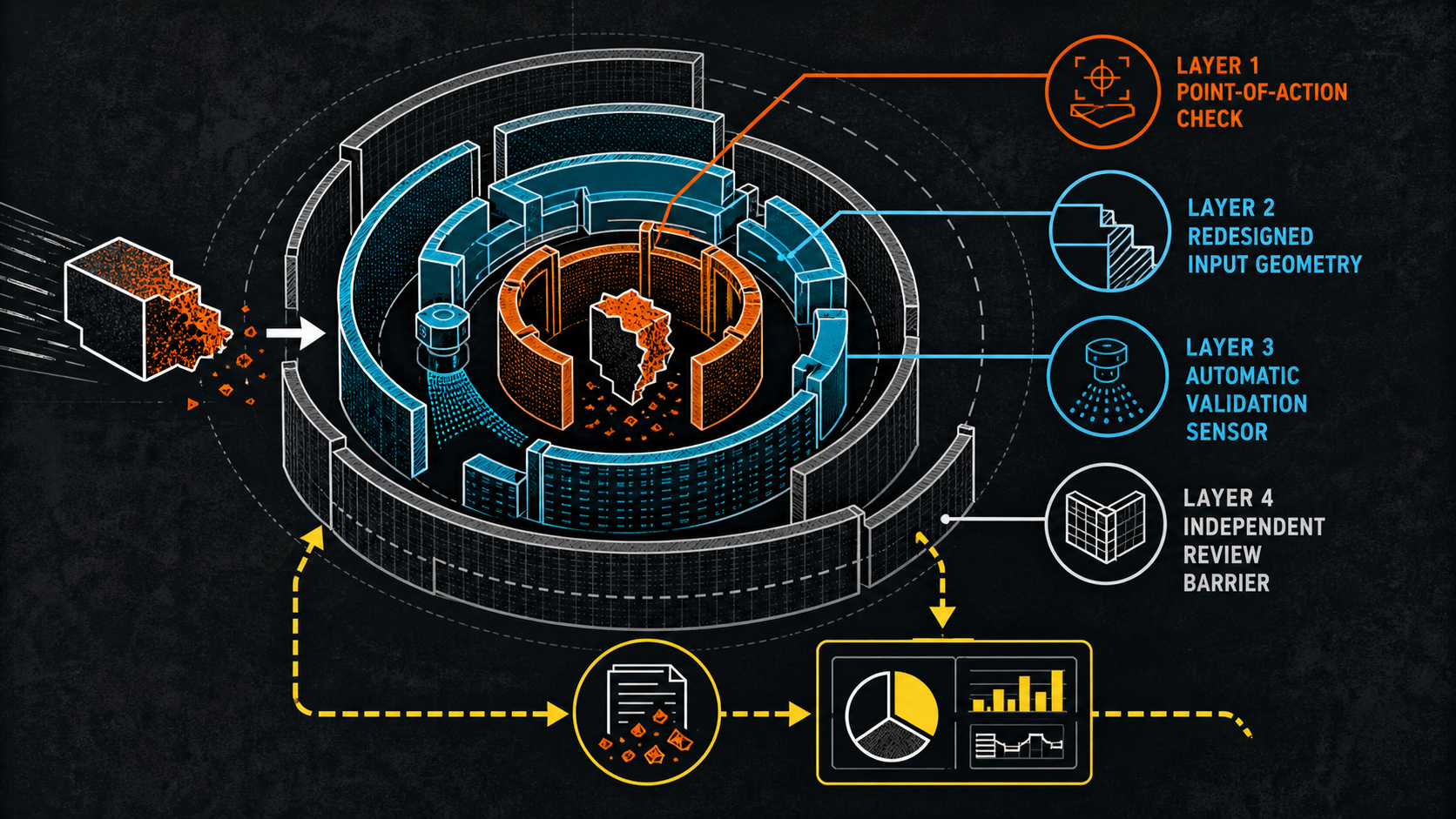
Each problem calls for a different response. Training may help when a usable check was never taught. It will not make unavailable evidence appear or prevent two nearly identical controls from being selected accidentally.
Keep a personal checklist when the fit is good
- The task and evidence are stable enough that the same check remains meaningful.
- The error has low or limited consequence under the applicable risk process.
- The item is observable and can be answered yes or no from an authorized source.
- The checklist appears at the decision point rather than in a distant document.
- Usage and results can be reviewed without surveillance or blame.
Keep the list short and based on real recurring errors. If a new item merely repeats an existing instruction, repair the wording or workflow instead of growing the list.
Redesign the process when the path creates the error
Look for a way to remove the confusing choice, supply the correct input automatically, separate similar items, establish one source of truth, make required fields unavoidable, or move the check closer to the source. A redesign should reduce opportunity for error without creating a hidden new risk.
UK Health and Safety Executive guidance says procedures should not be treated as the sole defence against human error and recommends understanding performance-influencing factors such as interface design, distraction, time pressure, workload, competence, and communication systems.
Process changes require the appropriate owner, testing, documentation, training, accessibility review, and change control. Do not alter a regulated, safety-critical, financial, clinical, or security process on personal initiative.
Use automated validation for stable detectable rules
- Presence: a required field, attachment, approval, or file is missing.
- Format: a date, identifier, version, or value does not match an allowed structure.
- Consistency: two connected fields or totals disagree.
- Range: a value crosses an authorized threshold and needs review.
- State: an action is attempted before a required preceding state is complete.
Automation is not automatically stronger. It can create false confidence, alert fatigue, inaccessible barriers, privacy problems, or silent failure when the rule or data changes. Define who owns the rule, how exceptions are reviewed, what happens when the validator is unavailable, and how its effectiveness is monitored.
Add independent review when consequence requires it
A second review is useful only when the reviewer is sufficiently independent, competent, authorized, and given the source evidence and time to challenge the result. Asking a colleague to repeat the same hurried visual scan is duplication, not necessarily an independent control.
Define what the reviewer checks, what evidence they use, how disagreements are resolved, and what must happen before release. High-consequence fields may require formal segregation of duties, approval, reconciliation, testing, read-back, or sign-off specified by the organization or regulator.
Do not use an article to decide controls for medicine, patient care, machinery, driving, public safety, security, law, tax, benefits, payments, regulated filings, or other high-consequence work. Use qualified domain expertise and the formal risk process.
Use consequence and repetition as an escalation map
- Low consequence, isolated: correct the item, clarify the expected state, and observe whether a pattern exists.
- Low consequence, repeated: inspect the workflow and environment before adding more checklist items.
- Moderate consequence or hard to detect: use an authorized process control, validation, or targeted review and monitor it.
- High or potentially irreversible consequence: stop relying on a personal checklist as the only barrier and use the required formal controls and escalation path.
This is a conversation frame, not a universal risk matrix. The organization or domain must define consequence, likelihood, detection, authority, and acceptable residual risk.
Borrow the principle—not the safety standard
The NIOSH hierarchy of controls ranks eliminating or substituting a workplace hazard and using engineering controls above administrative controls that depend on ongoing human action. That framework is for occupational hazards, not ordinary document mistakes, so its levels should not be copied mechanically into office workflows.
The transferable principle is narrower: when consequence justifies it, prefer controls that change the source or system and require less repeated human vigilance. FDA human-factors guidance for medical devices similarly emphasizes designing out use-related hazards and reducing reliance on manuals or training, but medical-device guidance does not establish requirements for a general office process.
Verify that the stronger control actually works
- Define the error and baseline period before changing the process.
- Test the control with representative users, inputs, environments, and permitted exceptions.
- Measure errors caught, errors missed, false alerts, delay, rework, accessibility, and new failure modes.
- Ask whether people bypass the control and why; do not hide usability problems behind blame.
- Assign an owner and review date for the control itself.
- Retire redundant checks only through the authorized process after the stronger control is verified.
Start with one repeated error
Choose one recent, low-risk repeated error. Write the observable event, where it entered, where it should have been caught, the consequence, and which condition made it easier. Then ask the process owner whether the right response is a clearer check, workflow redesign, validation, or independent review.
If attention, organization, or repeated-error difficulties persist across important areas and cause meaningful impairment, consider discussing the pattern with a qualified professional. Bring concrete examples and the controls already tried. Professional support does not replace correcting an unsafe or poorly designed work system.
Sources and further reading
Sources support the health and diagnostic context. Practical workflow suggestions are low-risk editorial adaptations, not clinical treatment.